- SMALL ORDERS FOR STANDARD ITEMS. Contact Now
- OUTDOOR COOLING SOLUTIONS, MADE IN‑HOUSE. Contact Now
- COOLER BOXES THAT FIT REAL OUTDOOR LIFE. Contact Now

 LANGUAGE
 日本語
 Español
 عربى

Industry News
34 Quart Cooler Guide: Real Capacity, Ice Retention, and Smart Buying Checks
Content
- 1 34 Quarts in Liters and Gallons: The Conversion Buyers Keep Rechecking
- 2 How Long a 34 Quart Cooler Holds Ice
- 3 Matching the Size to the Trip: People, Days and Load Types
- 4 Foam, Wall Thickness and Lid Fit: Where Performance Is Decided
- 5 Weight, Handles and Transport: Practical Checks Before You Order
Ask five buyers what a 34 quart cooler holds and you will get five different answers, because the number on the label describes the box, not the space you can actually fill. Thirty-four US quarts converts to about 32 liters, or roughly 8.5 US gallons. That places the format in the mid-size class: a comfortable two-person weekend box, a workable day box for a family of four to six, and a tight squeeze for a large group camping for a week. Everything beyond that depends on wall thickness, lid gasket quality and how you load it.
This guide covers the practical questions behind the size label. It explains how much food and ice really fit, how long ice lasts under summer conditions, and which specification points separate a sturdy box from a thin one. If you want the structural background first, our explanation of what a cooler box is walks through the shell, foam core and lid assembly that sit behind every capacity claim.
34 Quarts in Liters and Gallons: The Conversion Buyers Keep Rechecking
One US quart equals 0.9464 liters, so 34 quarts is 32.2 liters. Most manufacturers round that to 32 liters, and some round down to 30 liters when the internal mold is conservative. The practical conclusion is simple: when a listing says 34 quart, plan on 30 to 33 liters of gross internal volume, not 34 liters.
The second and larger gap is between gross volume and usable volume. Ice occupies space, and a common packing rule is to fill one third to one half of the interior with ice. That leaves a 32 liter box carrying roughly 16 to 21 liters of food and drinks. Buyers who compare a 34 quart cooler with a 45 quart model on label numbers alone usually underestimate what the larger box actually buys them.
| Quart label | Liters (approx) | US gallons (approx) | Typical trip profile |
|---|---|---|---|
| 20 qt | 19 L | 5.0 | Solo day trip, lunch and drinks |
| 28 qt | 26 L | 7.0 | Two people, one day |
| 34 qt | 32 L | 8.5 | Two people weekend, or family day out |
| 45 qt | 43 L | 11.0 | Family weekend, four to five people |
| 58 qt | 55 L | 14.5 | Group day event, market stall, tailgate |
Read the chart from the narrowest bar down. A large 58 to 80 liter box offers the biggest usable food volume, but it also demands the most ice, and a half filled large box performs no better than a well packed mid-size one. The 34 quart class sits in the middle band, delivering roughly 14 liters of usable food volume once ice takes half the space. That is enough for two days of meals for two adults, or one full day of food and drinks for five or six people at a picnic. The two compact bands below it cover solo trips and short outings, where weight and portability matter more than volume. Note how the bars grow faster than the ice requirement: doubling food volume does not double retention time, because the ice to content ratio and the exposed surface area both change. A buyer comparing a 34 quart cooler with a 45 quart model should ask what the extra six liters of usable space costs in weight, price and packing effort, not just in headline capacity.
How Long a 34 Quart Cooler Holds Ice
Insulation, not capacity, decides how long the ice survives. Two boxes with the same 32 liter interior can differ by a full day of retention once the wall construction changes, and that gap is exactly what users notice when a thin box is compared with a properly foamed one.
Three variables drive the curve: foam thickness and foam type, lid gasket sealing, and the ratio of ice to contents. Pre-chilling the box and starting with block ice instead of cubes can add hours on its own. The model below is a planning curve rather than a laboratory certificate, but the shape of the lines reflects how the three common constructions behave in summer heat.
The lowest curve belongs to a thin single wall box without a gasket. Roughly half of its ice is gone within six hours, and almost nothing useful remains after a full day outdoors. The middle curve represents a standard 20 mm polyurethane foam wall, which still holds about two thirds of the ice at the twelve hour mark and keeps a usable amount overnight. The top curve adds a thicker foam section plus a sealing lid gasket, and it holds more than half of the starting ice for nearly a full day. The distance between the curves widens over time instead of staying constant, which is why a short test is misleading when the real trip lasts two or three days. For a 34 quart cooler, the gap between the bottom and the top line is the difference between a lunch box and a weekend box. That is also why the same capacity can be sold at very different prices without any party being dishonest about the numbers.
Matching the Size to the Trip: People, Days and Load Types
Start from the load, not from the label. Two adults for a weekend need about 14 liters of food plus ice, which is exactly the 34 quart class. Five people for a single day need a similar volume but a flatter packing pattern, because bottles and trays take more footprint than the same weight of food. Three people for four days pushes past the format entirely and points toward a 45 liter box or a second container.
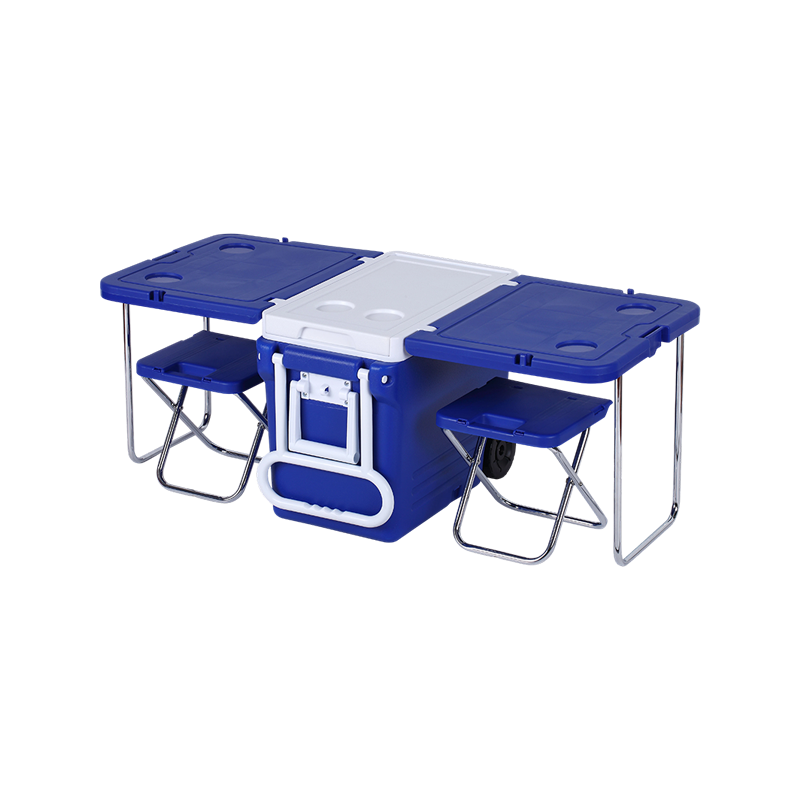 32L All-in-One Foldable Picnic Set Cooler with Table & StoolsSize: 505*355*398CMMM Volume: 32L Material: FOOD GRADE PP+PE+PU+IRON Weight: 7500GView Product →
The column chart below turns those scenarios into nominal capacities. It pairs each trip type with a size that keeps the ice to content ratio near one to one, which is the ratio that protects retention without wasting interior space on nothing but ice.
The tallest column appears next to the group event, which is the one scenario where a 34 quart cooler genuinely runs out of room. A couple on a weekend trip needs only about 32 liters, which is the same shelf size as the 34 quart format and the most efficient use of that interior. The family day column is slightly smaller, because a single day of food needs less volume than a weekend of it, even for more people. The multi-day camp column lands between the two, which is the point where many buyers discover that a mid-size box plus a separate water container beats one oversized cooler. Notice that the columns describe nominal box volume, not food volume, so the ice allowance is already included in each number. Anyone planning a three day trip with four people should treat the middle two columns as a warning rather than a target.
Foam, Wall Thickness and Lid Fit: Where Performance Is Decided
Polyurethane foam outperforms expanded polystyrene at the same thickness, and thickness matters more than most buyers expect. A 20 mm wall and a 30 mm wall look similar from the outside, yet they behave very differently after twelve hours in a hot car. Lid gaskets, hinge rigidity and latch tension decide whether that wall thickness is allowed to do its job, because a lid that lifts by two millimeters under load loses cold air continuously.
The radar view shows why thin wall coolers still sell: they win on portability, purchase cost and load flexibility, and they lose badly on ice retention and durability. The large shaded shape belongs to the thicker foamed construction, which dominates on retention and structural strength but gives ground on weight and price. Neither shape is wrong, because the two designs solve different problems for different buyers. What matters is that the trade is visible before the order is placed, rather than discovered after the first summer season. A buyer who needs a light box for day trips should not pay for 30 mm foam, and a buyer running multi-day programs should not accept a thin wall to save freight weight. The gap between the two shapes on the retention axis is the single largest difference on the chart, and it is the one specification worth defending in a quotation review.
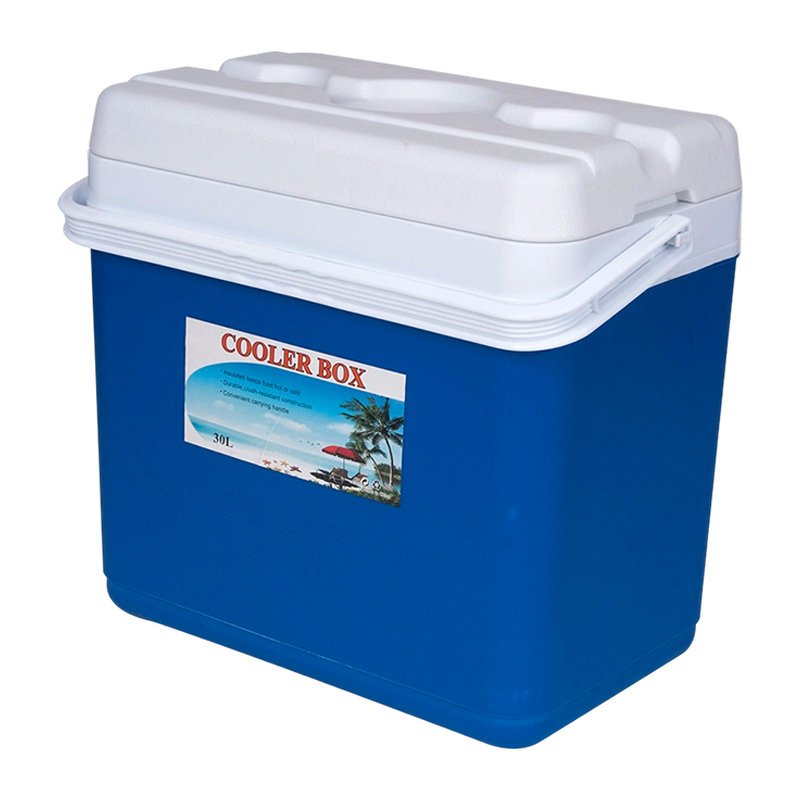 30L BPA-Free PORTABLE ICE BOXVolume: 30L Material: FOOD GRADE PP+PE+EPS Weight: 2600GView Product →
Material choice sits underneath all of this. Food contact surfaces, foam density and the grade of the plastic shell determine whether a box still performs in its third season, and whether it can be sold into markets with stricter material rules. Replaceable parts such as latches, hinges and drain plugs extend service life further and reduce the volume of returned units.
Weight, Handles and Transport: Practical Checks Before You Order
Once capacity and insulation are settled, the remaining risk is handling. A fully loaded 32 liter box weighs well over 20 kilograms, and the difference between a comfortable carry and a painful one usually comes down to details that never appear in a specification sheet.
- Check the loaded weight, not the empty weight, because ice and bottles add most of the mass.
- Confirm handle geometry and grip width for the people who will actually carry the box.
- Decide whether wheels and a telescopic handle are needed for long walks from a car park.
- Verify that the drain plug is reachable when the box is full and standing on the ground.
- Ask whether latches and hinges are replaceable, and whether spare parts can be supplied.
- Confirm carton dimensions and stacking limits, since a bulky box raises freight cost per unit.
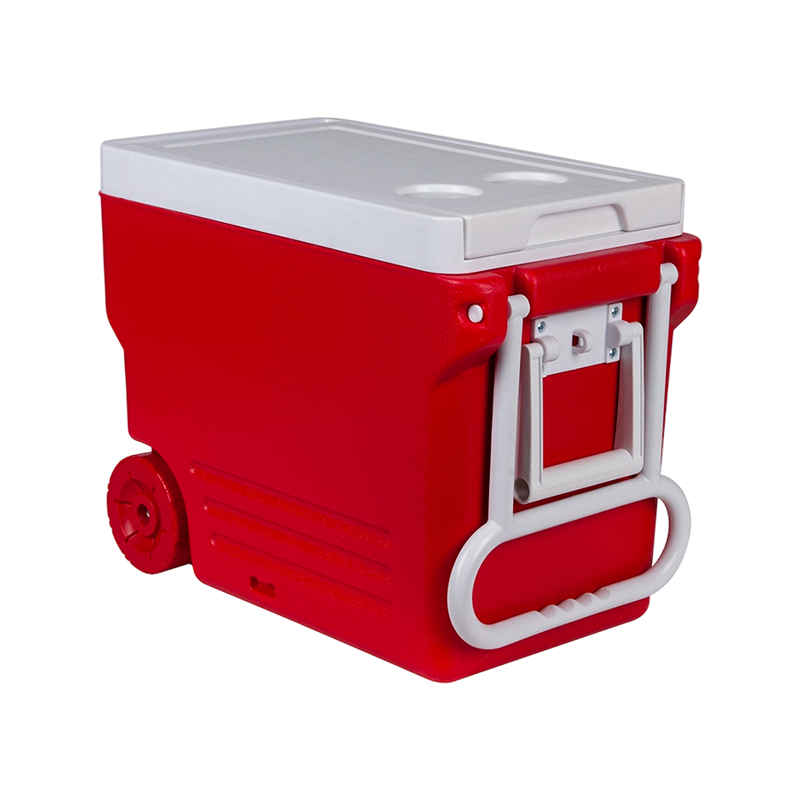 32L Rolling Cooler Box for Travel & PartiesCapacity: 32L Unit Weight: 4.1 KGS Materials: Inner: PP (Polypropylene) Outer Shell: PE (Polyethylene) Lid: PE (Polyethylene) Insulation Layer: PU (Polyurethane) Key F...View Product →
For picnic programs, parties and travel use, a rolling format removes most of the carrying objection and keeps the 32 liter interior intact. For fixed installations and market stalls, a lighter flat box is usually the better trade. The right answer depends on how far the box travels while it is full, which is a question worth asking before any tooling is committed.
A 34 quart cooler is a mid-size tool with a narrow sweet spot: two people for a weekend, or a family for a day. Match it to that job and it will feel generous. Push it beyond that and no insulation specification will save the trip, because there is simply not enough room left for ice. Buyers who clarify the loading pattern first usually end up with fewer returns, lower freight cost and a shorter, better justified product range.
Behind every box is a supply chain decision. Ningbo Junlong Outdoor Products has manufactured outdoor cooling and water storage products since 2000, running injection molding, blow molding, foaming and assembly inside a 12,000 square meter factory in Cixi, Zhejiang. Standard models accept small orders, and OEM or ODM projects can start from a drawing, a sample, or simply a target capacity and price. You can read more about the company and its manufacturing background, or send a requirement with capacity, insulation and quantity details to receive a quotation.
Product Recommendation
link
Office
- TEL: +86-574-63787606
- Phone: +86-13777994798
- E-mail: sales@nbjunlong.com
- WhatsApp: 13777967488
- Address: No. 1, Lane 3, Development Road, Longtouchang, Longshan Town, Cixi City, Zhejiang Province, China
Get In Touch
Copyright © Ningbo Junlong Outdoor Products Co., Ltd. All Rights Reserved.
China Plastic Insulated Cooler Box Manufacturer Custom Cooler Box Supplier
