- SMALL ORDERS FOR STANDARD ITEMS. Contact Now
- OUTDOOR COOLING SOLUTIONS, MADE IN‑HOUSE. Contact Now
- COOLER BOXES THAT FIT REAL OUTDOOR LIFE. Contact Now

 LANGUAGE
 日本語
 Español
 عربى

Industry News
45 Qt Hard Cooler Guide: Capacity, Ice Retention and Sourcing Facts for Buyers
Content
Most buyers who outgrow a small box end up on a 45 qt hard cooler, and the reason is simple: it is the smallest size that still swallows a full weekend of food and drinks without forcing a repack every few hours. The catch is that 45 quarts is a nominal label, not a usable cavity. In the US quart convention that is about 42.6 litres of external volume, and once you subtract wall thickness, the moulded base and the space a couple of ice packs take up, the working space is usually closer to 36 to 39 litres.
That gap is where most disappointment starts. Two boxes with the same 45 qt label can behave very differently, one holding ice for four days and the other for barely one and a half, because the deciding factors are foam type and density, wall thickness, lid gasket quality and how tightly you pack the load. This guide covers what a 45 qt hard cooler realistically holds, how retention changes with temperature, and which specifications to confirm before you buy a single unit or place a bulk order.
What a 45 Quart Hard Cooler Actually Holds
One US quart equals 0.946 litres, so 45 qt converts to 42.6 litres, which is roughly 1.5 cubic feet. That places it one step above the common 35 qt size and one step below the 60 qt family size. In practice, a 45 qt box packed with a two to one ice to content ratio carries about 40 to 48 standard 355 ml cans, or around 25 to 30 one litre bottles, or enough fresh food for three to five people over a weekend.
| Nominal size | Litres | Cubic feet | Typical working load |
|---|---|---|---|
| 24 qt | 22.7 L | 0.8 | Day trip for two people |
| 35 qt | 33.1 L | 1.2 | Overnight trip for two |
| 45 qt | 42.6 L | 1.5 | Weekend for three to five |
| 60 qt | 56.8 L | 2.0 | Weekend for five or longer trips |
| 75 qt | 71.0 L | 2.5 | Group trips and bulk food |
Real internal volume in litres for five common nominal cooler sizes. Values are rounded to one decimal place.
The chart compares the nominal quart label with the real litre volume for five common cooler sizes. Reading across the bars, the jump from 35 qt to 45 qt adds roughly 9.5 litres of internal space, which is close to a full 24 can pack. The 45 qt bar sits in the middle of the range, which is exactly why it is treated as the crossover size between personal and family use. Moving up to 60 qt adds another 14 litres but also pushes the loaded weight past 20 kilograms, which matters if the box has to be carried any distance by hand. Buyers who regularly move a cooler alone usually stop at 45 or 50 qt, while those who load a vehicle or a boat keep climbing.
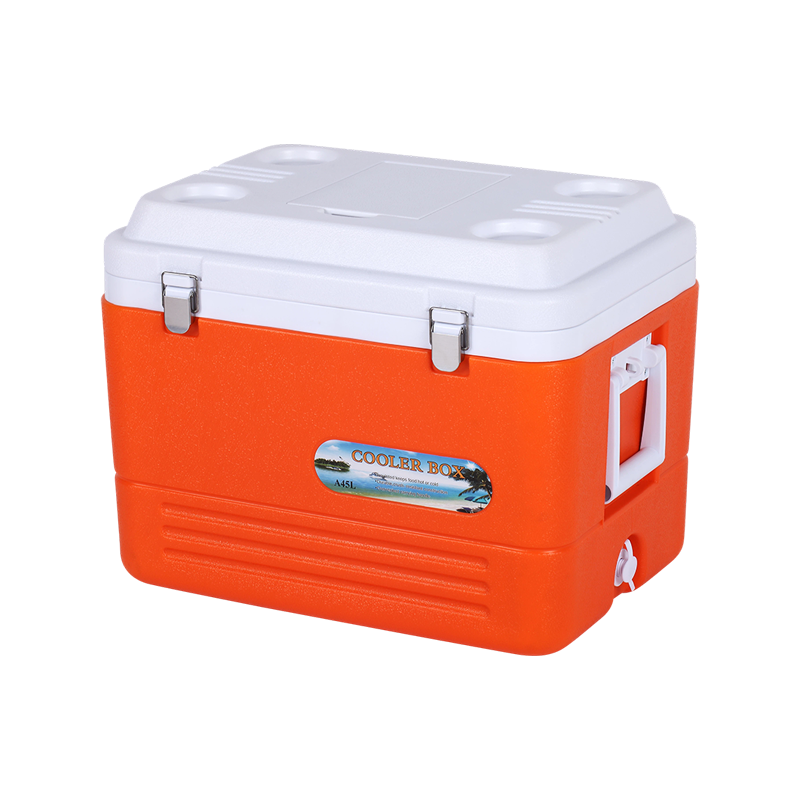 45L Large Capacity Foam Insulated Cooler with SkylightSize: 565*380*420MM Volume: 45L Material: FOOD GRADE PP+PE+PU Weight: 5600GView Product →
Ice Retention: How Long Ice Really Lasts in a 45 Qt Box
Retention is decided long before the first bag of ice goes in. Polyurethane foam holds its shape and insulation value far better than expanded polystyrene, a thick lid with a continuous gasket keeps cold air trapped, and a tight seal at the drain plug stops meltwater from leaking and warm air from entering. Pre-chilling the box for an hour with a sacrificial bag of ice, then packing at a two to one ice to contents ratio, can add a full day of usable cold compared with an unpacked, warm cooler.
Estimated ice retention hours at five ambient temperatures, assuming a two to one ice to content ratio and a lid that stays closed.
The lines show estimated ice retention hours at five ambient temperatures for two constructions that both carry a 45 qt label. The gap between them is modest in mild weather and widens sharply as the temperature climbs. At 20 degrees Celsius the well insulated box holds ice for about four days, while the thin walled box struggles to reach two. At 40 degrees Celsius the same pair falls to roughly 36 hours and 16 hours, which is the difference between a usable weekend and a wasted trip. The shape of each line matters as much as the values, because retention drops faster than most buyers expect once ambient temperature passes 30 degrees Celsius, so a cooler that performs well in spring can disappoint in a heatwave.
Wall Construction, Foam and Weight
Weight is the price you pay for insulation. A thick polyurethane layer and a rigid double wall keep cold air in, but they also add kilograms that have to be lifted in and out of a vehicle. For a 45 qt hard cooler used by one person, an empty weight above about 9 kilograms becomes awkward once the box is loaded, which is one reason manufacturers keep handles, drain plugs and lid geometry as simple as possible.
Empty weight in kilograms for four constructions that can all be sold as a 45 qt hard cooler or its nearest equivalent.
These columns compare the empty weight of four cooler constructions that all carry a 45 qt label or its nearest equivalent. Weight is not a fault on its own, but it decides how the cooler gets moved, how much payload a vehicle or a boat can carry, and how many units fit on a pallet. Rotomoulded bodies are the heaviest at roughly 14 to 15 kilograms empty, because the shell itself is several millimetres thick. Foam insulated blow moulded boxes sit in the middle at around 8 kilograms, and thin walled boxes and soft bags sit at the bottom of the scale. For a 45 qt hard cooler carried by one person, anything above about 9 kilograms empty becomes noticeable the moment the box is full.
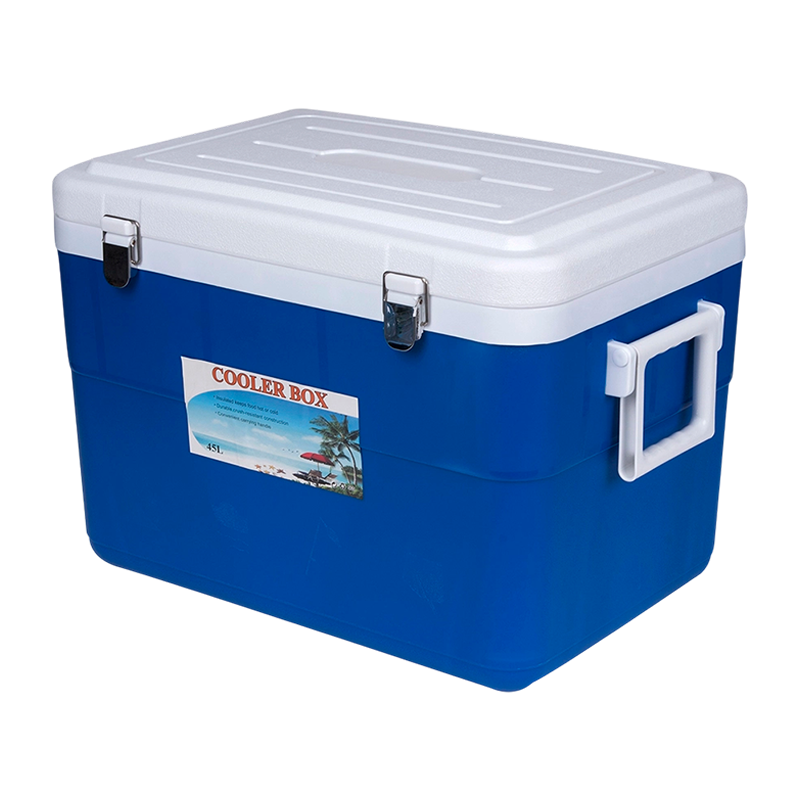 45L Fishing Large Cooler Box with Foam InsulationVolume: 45L Material: FOOD GRADE PP+PE+EPS Weight: 4200GView Product →
Hard Cooler, Soft Cooler or Rotomoulded
There is no single best construction, only the one that matches your two or three non negotiable criteria. The radar comparison below scores three shapes against the criteria buyers weigh most often, using a simple 0 to 100 scale rather than absolute claims.
Relative scores from 0 to 100 across five buying criteria. Higher values indicate stronger performance on that criterion only.
The radar chart scores two cooler types across five criteria that buyers weigh most often, using a 0 to 100 scale for comparison rather than absolute performance. The hard foam insulated box leads on ice retention and durability but sits lower on portability, which reflects the reality of a rigid body and fixed handles. Soft sided coolers score well on portability and price but lose ground on retention, because flexible walls cannot hold a thick foam layer. A rotomoulded design would plot even further out on durability and retention, at the cost of weight and price. The useful takeaway is that no single shape wins every axis, so the right choice depends on which two or three criteria you cannot compromise on.
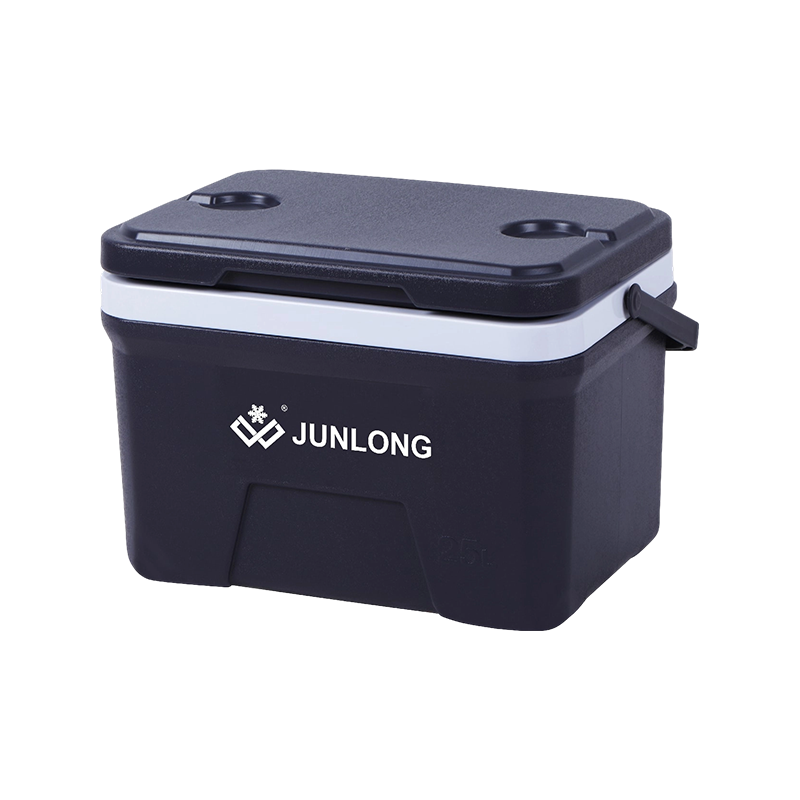 45L Outdoor Foam Insulated Cooler with Cup HolderSize: 530*380*370MM Volume: 45L Material: FOOD GRADE PP+PE+PU Weight: 4900GView Product →
What to Confirm Before You Buy or Source
Whether you are buying one box for personal use or placing a container order, the same checklist applies. Ask for the numbers rather than the marketing language.
- Real internal volume in litres, measured inside the liner rather than quoted from the outer mould.
- Foam type and density, since polyurethane foam and expanded polystyrene behave very differently over a long trip.
- Wall thickness at the base, the lid and the corners, because cold loss happens at the thinnest point, not the average.
- Lid gasket, hinge and latch design, and whether replacement parts can be supplied separately.
- Empty weight, handle geometry and drain plug position, tested with a full load rather than an empty box.
- The ice to content ratio you plan to use, since a box packed full of warm food will never match a test result.
Most quality problems on a 45 qt hard cooler trace back to how the insulation was formed, not how the shell was assembled. Working with a supplier that controls moulding, foaming and assembly inside its own plant removes a large part of that risk, because the variables that decide retention stay under one roof instead of being split across several subcontractors.
Manufacturing and Batch Consistency
Insulation performance is set during foaming, and foaming is where supplier differences show up first. A vertical manufacturer runs its own injection moulding, blow moulding and foaming equipment, which means density, cure time and liner fit can be held to the same numbers from the first sample to the hundredth container. That consistency is what large buyers actually pay for, because a cooler that performs well in a hand built sample but drifts in mass production creates returns, not repeat orders.
For custom programmes, the practical questions are whether colour, logo and packaging can be changed without altering the mould, how long tooling takes, and whether the same line handles both standard and custom runs. Suppliers who document the process from moulding through packaging make that conversation much easier to close, since every stage has a named owner and a measurable output. This is also the point where small trial orders matter, because a small first shipment is the cheapest way to verify foam quality, lid fit and finish before committing to a full production run.
Buyers who want the detail behind these claims can review how process control runs from moulding to packaging on a single production site.
A 45 qt hard cooler is a sensible middle size, but the label tells you very little on its own. Before committing, confirm the real internal cavity in litres, the foam type and density, the wall thickness at the base and lid, the gasket design and the empty weight. Then match those numbers to how the box will actually be used: how many people, how many days, and how far it has to be carried.
Volume buyers should add two more checks to that list. Ask for a sample drawn from the production run rather than a hand built prototype, and confirm that the moulding and foaming stages are controlled in house, because insulation performance is decided long before the final assembly line. Settle those points early and the 45 qt size will do exactly what it promises.
Product Recommendation

link
Office
- TEL: +86-574-63787606
- Phone: +86-13777994798
- E-mail: sales@nbjunlong.com
- WhatsApp: 13777967488
- Address: No. 1, Lane 3, Development Road, Longtouchang, Longshan Town, Cixi City, Zhejiang Province, China
Get In Touch
Copyright © Ningbo Junlong Outdoor Products Co., Ltd. All Rights Reserved.
China Plastic Insulated Cooler Box Manufacturer Custom Cooler Box Supplier
