- SMALL ORDERS FOR STANDARD ITEMS. Contact Now
- OUTDOOR COOLING SOLUTIONS, MADE IN‑HOUSE. Contact Now
- COOLER BOXES THAT FIT REAL OUTDOOR LIFE. Contact Now

 LANGUAGE
 日本語
 Español
 عربى

Content
A locked lid is the whole difference. In parks that require bear resistant food storage, a cooler without a padlock through its latches is treated as an open container, no matter how thick its walls are or how much it cost. The National Park Service has stated this plainly for well known cooler brands: without locks, those models are not acceptable bear resistant food containers.
That single rule filters most of the market. A cooler qualifies as bear resistant only when two conditions are met at the same time. The hardware must keep the lid shut under force, and the specific model must have passed a live bear test run under an approved program, with results normally listed by the Interagency Grizzly Bear Committee, or IGBC. Rugged styling, rope handles and thick foam do not substitute for either condition.
The sections below explain how the test works, which design details decide whether a cooler passes, how capacity choice interacts with locking hardware, and what a buyer should ask before ordering.
How Bear Resistant Certification Actually Works
Certification is a test result, not a material claim. In the format used for coolers and food containers, a live bear is given access to a closed and locked container for a set period, commonly around one hour. The container passes when the animal cannot open it, cannot create an opening large enough to reach the contents, and does not damage it so severely that it would fail a second round. Testing takes place at facilities where bears already work on enrichment objects, which is what makes the results repeatable enough for land managers to rely on.
Two consequences follow from that.
- The result belongs to one model in one configuration. A certified body size does not automatically cover a larger version, and a certified cooler stops being certified the moment the latch is replaced with a different casting, the hinge pins are swapped, or the padlock is left at home.
- Lists matter more than labels. Managers in grizzly country publish or reference approved product lists, and a ranger checks the list rather than the wording printed on the lid.
For campers the practical version is simple: lock the cooler, keep the model on the approved list, and treat the box as sealed storage rather than a snack cabinet that opens whenever someone is hungry.
The Design Details That Decide a Pass or Fail
A bear works on the weakest geometry, not the thickest panel. In practice that means the corners, the lid edge and the latch area. Insulation thickness affects ice retention, but hardware and shell structure decide whether a container survives an hour of focused pressure.
Latch and lock geometry
Latches need a through hole sized for a real padlock shackle, typically in the range of 6 to 8 mm, positioned so the shackle cannot be twisted away from the body or cut in one easy reach. Recessed hardware helps, because a latch that sits flush or slightly below the shell line gives claws and teeth less to grip. Two latches on a mid size box and three or more on a large one spread the load and remove the single point of failure.
Lid overlap and hinge strength
A deep lid skirt that overlaps the body wall resists prying far better than a shallow lid resting on a rim. Hinges should use stainless pins with full length engagement, because a hinge that pulls out turns a locked cooler into an open one in a single move.
Shell and insulation structure
Most large insulated boxes are built as a molded outer shell, a molded inner liner, and a foam layer between them. Understanding how a cooler box is built explains why the latch mounting area is only as rigid as the shell behind it. Uniform foam density and consistent wall thickness are what stop a latch bolt from tearing out of the plastic under load.
Drain plugs and small parts
Anything removable by hand is a weak point. A captive drain plug that stays attached to the body, and fittings that cannot be unscrewed without a tool, close gaps that a bear will otherwise find and exploit.
Matching Capacity to Trip Length and Group Size
Capacity influences bears less than hardware does, but it changes how many latch points a design needs and how much weight one person can realistically move. The three size classes used by most suppliers map roughly to the following use cases.
| Capacity range | Typical group | Trip length | Hardware to look for |
|---|---|---|---|
| 5L to 13L | 1 to 2 people | Day trips, one overnight | Two latch points, carry strap, captive plug |
| 15L to 38L | 2 to 4 people | 2 to 3 days | Two to three latches, reinforced hinge, wheels or dual handles |
| 45L to 80L | 4 or more, base camp | 3 days or longer | Three or more latches, wheeled base, telescopic handle |
A full 60L cooler can weigh well over 30 kg once it is packed, so a wheeled base matters as much as insulation. For base camps and fishing trips where the box stays in one spot and is opened twice a day, a rugged 60L class unit with a dedicated ice pack compartment holds enough food for four people while keeping the lid closed the rest of the time.
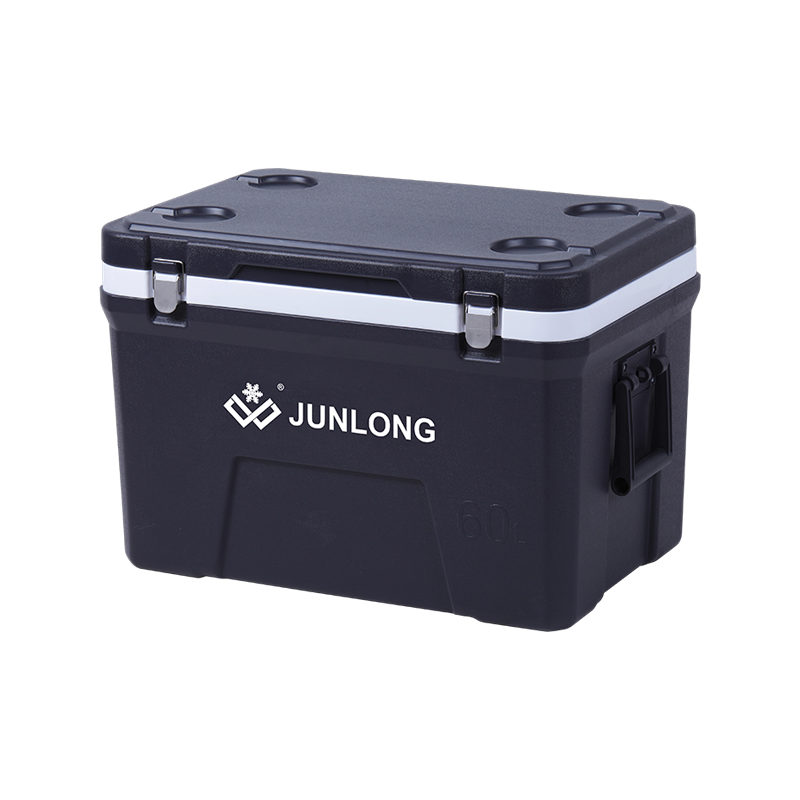 JUNLONG 60L Rugged Cooler Box with Ice Pack CompartmentRugged 60L insulated cooler with dedicated ice-pack compartment suits base camps and fishing trips, keeping food chilled between twice-daily openings.View Product →
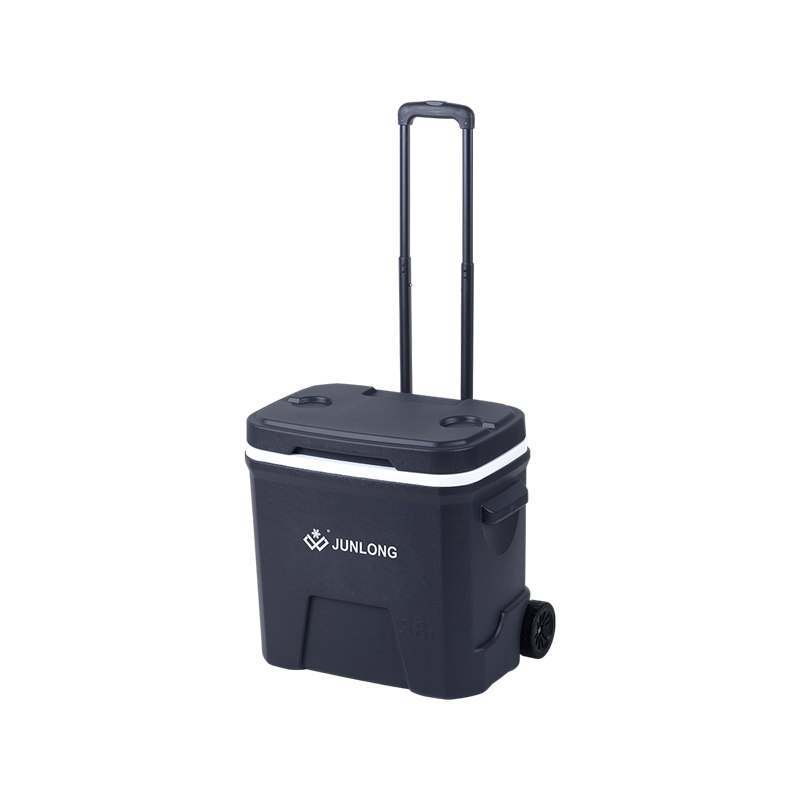
When the camp moves every morning, a wheeled mid size box is easier to relocate and still gives enough room for food, ice and a few drinks. Reducing the number of people needed to move the food supply is a safety benefit as well as a convenience one, because the cooler gets locked again sooner at the new site.
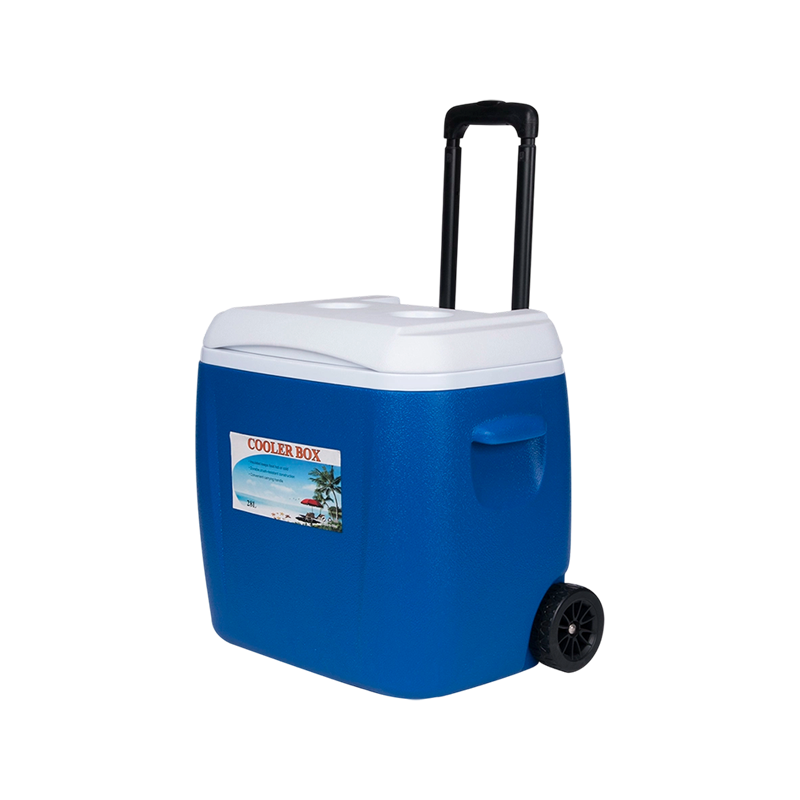 28L Wheeled Insulated Cooler Box for Camping and Outdoor UseA 28L wheeled cooler with telescoping handle and heavy-duty wheels makes relocating food, ice, and drinks easier when camp moves each morning.View Product →
One more habit reduces risk on any trip: keep drinks in a separate container so the food cooler stays shut between meals. Every unnecessary opening is a chance to forget the padlock. A portable insulated water jug with a faucet handles that job without touching the food store.
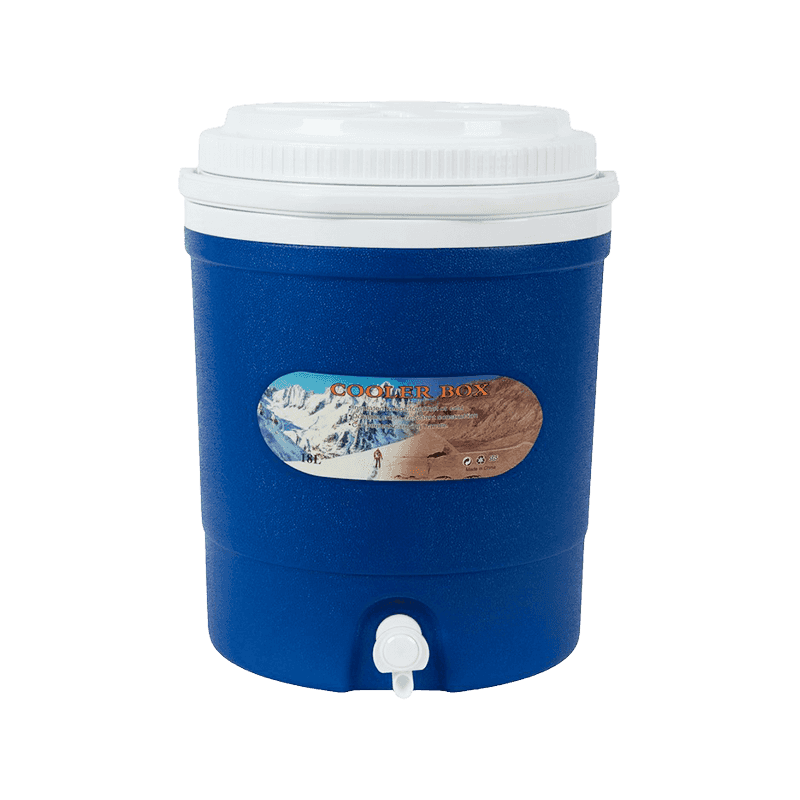 JUNLONG 18L Portable Insulated Water Jug with FaucetFood-grade 18L insulated water jug with built-in faucet keeps drinks separate from food and serves easily at outdoor events.View Product →
What Buyers Should Ask Before Sourcing
When a cooler is sold into parks markets in the United States and Canada, the certification question arrives quickly, usually from the customer rather than the retailer. A few questions separate a genuine program from a decorative one.
- A model specific test report, not a general statement that the factory makes bear resistant products.
- The latch casting drawing, including through hole diameter and the padlock sizes that fit it.
- Foam type and density, shell material and nominal wall thickness at the latch mounting boss.
- Hinge pin material and engagement length, plus the retention method for the drain plug.
- Whether latch hardware, lock holes, colors, logo and packaging can be adjusted for a private label program.
- The minimum order quantity for standard models, so a first order can be tested in the market before scaling.
Factory structure answers part of this list before the questions are even asked. Companies that keep molding, foaming and assembly under one roof can hold wall thickness and foam density within a tighter band, which is exactly what determines whether a latch bolt survives a hard pull. A vertically integrated outdoor cooling manufacturer with its own injection, blow molding and foaming equipment can also adjust latch and lock hole tooling for OEM orders without waiting on an outside molder, which shortens the path from drawing to sample.
It is worth stating the boundary clearly during any negotiation: an OEM project can be built to a customer specification, including reinforced hardware and lock holes, but the certification itself must be earned by that final configuration through testing. A supplier that promises certification before testing is a procurement risk, not a shortcut.
A Short Field Checklist
- Confirm the exact model number appears on the approved list for the area you are visiting.
- Padlock every latch, not only the front one.
- Test the padlock fit at home, not at the trailhead.
- Relock the cooler after each meal and before leaving camp.
- Store drinks separately so the food cooler stays closed.
- Never modify latches, hinges or drain plugs.
- Clean and dry the box after the trip to protect the gasket and hardware.
A bear resistant cooler is a system of three parts: a tested model, intact hardware, and a lock that is actually used. The first two can be bought. The third is a habit, and it is the one that decides whether the food is still there in the morning.
Product Recommendation
link
Office
- TEL: +86-574-63787606
- Phone: +86-13777994798
- E-mail: sales@nbjunlong.com
- WhatsApp: 13777967488
- Address: No. 1, Lane 3, Development Road, Longtouchang, Longshan Town, Cixi City, Zhejiang Province, China
Get In Touch
Copyright © Ningbo Junlong Outdoor Products Co., Ltd. All Rights Reserved.
China Plastic Insulated Cooler Box Manufacturer Custom Cooler Box Supplier
